-
Goodbelly is a line of probiotic juice products. The product was launched in 2018 and is available nationwide in retailers like Wholefoods and Safeway.
-
In May-July of 2010 the company spent money on in store product demonstrations in SELECT Wholefoods store regions. Goodbelly is trying to understand what, if any, impact the in store demonstrations might have on sales and profitability. Basically is is worth it? And, if so, where is it worth it?
-
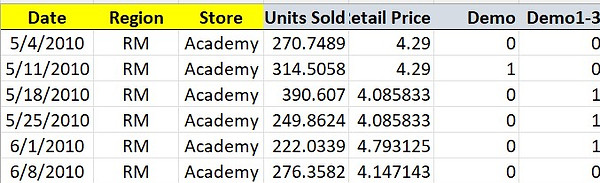
Dataset: Goodbelly provided us with a dataset that has data from the Rocky Mountain (RM) and Northeast (NE) regions. The data includes: units sold, retail price, demo: a dummy code for if the demo occurred in the past week, and finally demo1-3: another dummy code for if the store had a demo not as recently but still 1-3 weeks ago. 1=yes, 0=no

Here, I estimated the sales response models for the RM and NE regions separately. For both models, sales is a linear function of price, demo and demo 1-3.
RM

NE

In the Rocky Mountain region: For every dollar Goodbelly increase their beverage price by, their sales will see a decrease by about 77. For every Demo Goodbelly does in the same week, they will see an increase of 130 in sales. For every Demo Goodbelly does within 1-3 weeks, they will see a 89 person increase in sales.
In the Northeastern region: For every dollar Goodbelly increase their beverage price by, their sales will see a decrease by about 36. For every Demo Goodbelly does in the same week, they will see an increase of 107 in sales. For every Demo Goodbelly does within 1-3 weeks, they will see a 63 person increase in sales.
mated the sales response models for the RM and NE regions separately. For both models, sales is a linear function of price, demo and demo 1-3.
I then put both the RM and NE region data together and created a model with a common intercept, price, demo and demo 1-3 coefficient.

My conclusions about the effect of demos on sales are that they generally improve them. Having a demo within a week of selling the probiotic drink increases Goodbelly's sales in a larger way but having a demo 1-3 weeks still maintains a positive and significant effect on overall sales.
With a 1$ increase in retail price, there is a decrease in sales by 48.7 units. With a demo, Goodbelly sees an increase in sales by 136.268 units and with a demo 1-3 weeks prior, Goodbelly sees an increase in sales by 87.9 units.
I was then asked to provide statistical guidance on whether the price coefficient and demo/ demo 1-3 are statistically significant across regions. Meaning in specific regions where is it worth doing demos and how often is it worth doing them?
In order to answer this, I looked at 4 regression based models with different interactions considered.
-
Model 1: different intercepts only
-
Model 2: different intercepts and price coefficients
-
Model 3: different intercepts and demo/demo1-3 coefficients
-
Model 4: different intercept, price and demo/demo1-3 coefficients.
*I found that the second model was the only model that proved to be totally significant:
-
Model 2: All statistically significant. $1 increase in price leads to a decrease in sales by 34 units. With a demo leads to an increase in 124 units and with a demo in the past 1-3 weeks leads to a 79 unit increase. When the region is in RM there is a 223.5 unit increase. Additionally while having a 1$ increase in the RM region there is still an increase in units sold by 43.49 units. This is the best model to use.

I then used my model 2 to test for an effect of running demos in all stores in RM and NE markets for the week of July 20th assuming the retail price in each store will remain at July 13, 2010 weekly prices for the week of July 20 and any subsequent weeks.


Using this model, I found an expected profit of $39,175.77
I was able to break down profit by week and by individual store.
I then wanted to see how important the effect of having a demo in the past 1-3 weeks was. I call this the dynamic demo effect and I took away the variable “demo 1-3” in my model to investigate if the dynamic demo has a significant effect in the weeks subsequent to a promotion.
I found that taking away the dynamic demo effect in the weeks 1-3 weeks before, reduces profits by $6,942.88

